
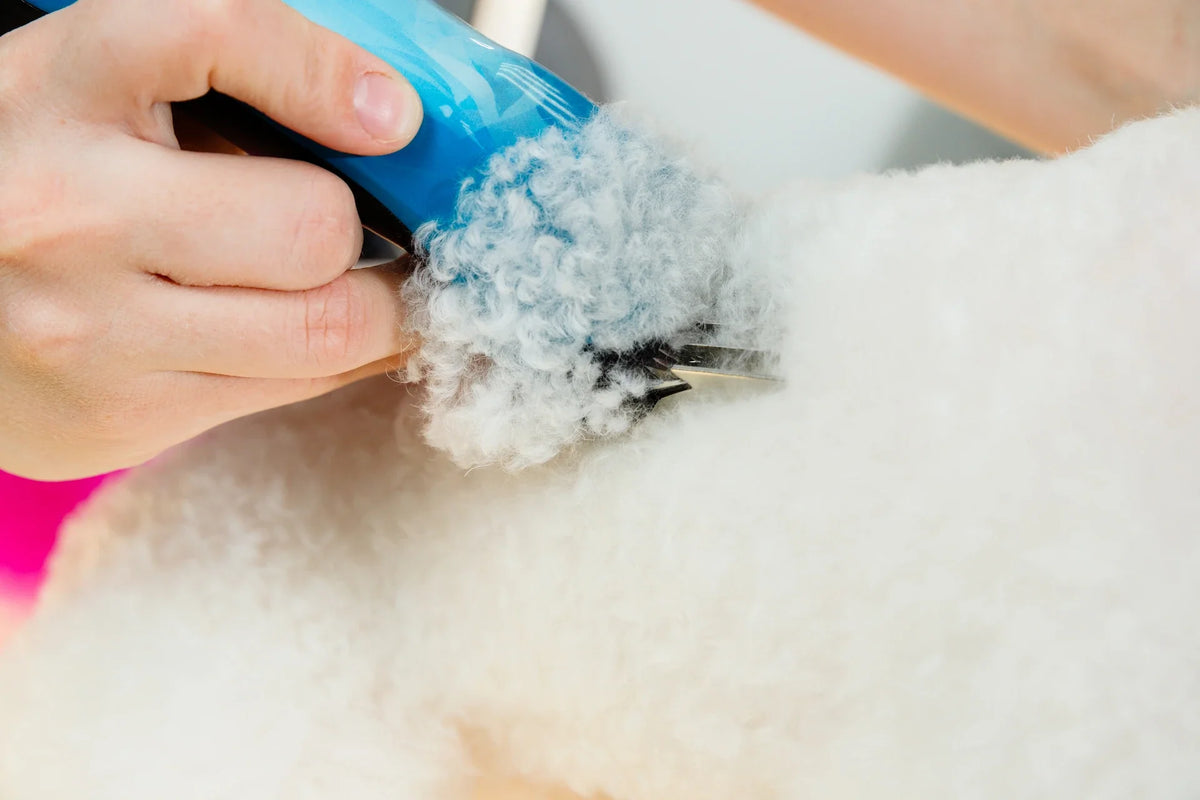
Clipper blade numbers run backwards: the higher the number, the shorter the cut. On the dog clipper blade sizes chart below, a #10 leaves 1/16 inch (1.5 mm), a #7FC leaves 1/8 inch (3.2 mm), a #5FC leaves 1/4 inch (6.3 mm) and a #4FC leaves 3/8 inch (9.5 mm), the lengths Andis publishes for its UltraEdge and CeramicEdge lines. Everything after that is tooth spacing, blade width and which way the coat lies.
Here is every common A5 size, what it leaves in inches and millimeters, and the job it does at the table.
Dog clipper blade sizes chart
| Blade | Leaves (inches) | Leaves (mm) | Usual job |
|---|---|---|---|
| 50SS | 1/125" | 0.2 | Surgical prep |
| 40 | 1/100" | 0.25 | Surgical and close vet prep |
| 35 | 1/75" | 0.35 | Sits between a 40 and a 30 |
| 30 | 1/50" | 0.5 | Base blade under snap-on guide combs |
| 15 | 3/64" | 1.2 | Pads and close face work |
| 10 | 1/16" | 1.5 | Sanitary prep, stomach, ears, face |
| 9 | 5/64" | 2.0 | Short head and neck work |
| 8 1/2 | 7/64" | 2.8 | Close body work and blending |
| 7 and 7FC | 1/8" | 3.2 | Very heavy or very matted coats |
| 5 and 5FC | 1/4" | 6.3 | Medium body length, slightly matted coats |
| 4 1/2 FC | 5/16" | 7.9 | A touch longer than a 5 |
| 4 and 4FC | 3/8" | 9.5 | Long body clips, front of forelegs |
| 3 3/4 and 3 3/4 FC | 1/2" | 13 | The longest common finish blade |
| 5/8" HT | 5/8" | 16 | Legs and body past a 3 3/4 |
| 3/4" HT | 3/4" | 19 | Longest length on the UltraEdge chart |
| T-10 | 1/16" | 1.5 | A #10 length on a wider head |
| T-84 | 3/32" | 2.4 | Short body work on a wider head |
Where these numbers come from
The 50SS and 35 lengths come from Andis's blade guide, and the 9, 8 1/2 and 4 1/2 FC lengths from the Andis blade chart. The rest sit on the published UltraEdge and CeramicEdge charts.
Direction of the coat changes the finish
One caution before you quote a length to a client. Those numbers assume you are clipping against the lie of the coat. Andis's own blade guide points out that a #7 run with the lie of the coat leaves roughly what a #5 leaves against it, so direction moves the finish as much as the blade number does.
How do you read a clipper blade number?
The number is a length code, not a size. Low numbers leave coat on, high numbers take it off, and the jump between neighbours is rarely even: a #5 at 6.3 mm and a #4 at 9.5 mm are three millimeters apart, while a #30 at 0.5 mm and a #40 at 0.25 mm are a quarter of a millimeter apart.
That matters most at the short end. Swapping a #15 for a #30 on a sanitary trim more than halves what is left behind, which is why groomers tend to own the whole short range rather than guess.
At the long end the gaps get wide enough that guide combs fill them. Once a client asks for anything past half an inch, you are usually working with combs over a short blade rather than a longer blade.
What do the letters on a clipper blade mean?
The letters describe the tooth pattern and the head, never the length. Andis lists a 7 skip tooth and a 7FC at the same 1/8 inch (3.2 mm) cut, so the difference between them is how the teeth are spaced, not how short the dog ends up.
- FC (finish cut): closely spaced teeth for a smooth finish. The UltraEdge 5FC is sold as a finish cut that leaves 1/4 inch (6.3 mm).
- Skip tooth: alternating tooth heights that bite into dense or matted coat, at the same length as the FC version of that number.
- FT, CT and similar: brand variations on tooth design, again at the chart length.
- T: a wider head. The Andis T-10 cuts the same 1/16 inch as a #10 but across a wider blade, so it is not a swap for tight work around pads and ears.
- HT: the long finishing blades, 5/8 inch and 3/4 inch.
- W or wide: a wider head for covering big bodies faster.
Which blade for which part of the dog?
Andis's grooming chart gives a starting point that holds for most pet trims: a 7FC on the head, 7 or 7FC down to 5 or 5FC on the body, sides and back, 5 or 5FC to 4 or 4FC on the front of the forelegs, and 10 to 15 on the neck, ears, face and cheeks. Pads take a 15, sanitary prep a 10.
For matting, the same chart moves you shorter as the pelt gets tighter: 5 or 5FC for a slightly matted coat, 7 or 7FC for a very matted one, and a 7 for very heavy coats. Legs are the exception, where it lists the long end: 3 3/4 FC, 5/8 inch HT, 3/4 inch HT or combs.
Treat it as a floor, not a rule. Coat type, how the dog stands and what the owner asked for will move you a blade in either direction, and most salons settle on their own house combinations over time.
Do blade numbers mean the same thing on every brand?
The fitting usually does, the length not always. Wahl notes that its KM Cordless takes all detachable A5 style blades on the market, and Andis sells its UltraEdge 7FC to fit AG, AGC, BG, DBLC, FHC, MBG and SMC clippers as well as the Oster A5.
Lengths drift between makers. Wahl's detachable range runs from a #3F at 10 mm down to a #50 at 0.4 mm, while the Andis chart puts its 3 3/4 FC at 13 mm. Same end of the chart, three millimeters apart.
The safest habit is to read the millimeters, not the number. Artero prints them on the blade itself, which is why the Artero Nº 3F in our range is marked 13MM and the Nº 5F is marked 6MM.
How do you cut longer than half an inch?
With guide combs over a short blade. Wahl's guidance is to run attachment guide combs over a #30, which gives lengths up to 1 inch of coat without changing blades for every pass.
Comb sets cover the gap the blade chart leaves open. The Andis 8 piece wide blade attachment comb set we stock runs 1/8", 1/4", 3/8", 1/2", 5/8", 3/4", 7/8" and 1", which is the whole teddy bear and puppy cut range off one base blade.
Keep the base blade sharp and clean. A comb only holds the coat off the skin; the blade underneath still decides how even the finish is.
What a working salon keeps on the table
Most grooming rooms run a core set and buy depth around it: a 10 and a 15 for sanitary work and pads, a 30 as the comb base, and a 7F, 5F and 4F for body length. Everything else is breed specific or a second set so the first can go out for sharpening.
Pet Palette carries that core across brands in our blades and shears range, including Andis UltraEdge and CeramicEdge sets such as the #10 UltraEdge at 1/16" (1.5 mm), the #30 UltraEdge at 1/50" (0.5 mm) and the #5FC CeramicEdge at 1/4" (6.3 mm), plus Artero blades marked in millimeters. If you are building a bench from scratch, the clippers and detachable blade sets and the wider Andis pro grooming line sit alongside them.
A spare set beats a sharpening emergency. Blades that cut hot or drag cost you time on every dog, and a second 10 and 7F in the drawer keeps a full book moving.
Common questions about clipper blade sizes
What is a 30 blade used for in dog grooming?
A #30 leaves 1/50 inch (0.5 mm), so it is too short for most finished pet work on its own. Its main job is sitting under snap-on guide combs, and Wahl's guidance is to run attachment combs over a #30 for lengths up to 1 inch.
How short is a 10 blade in dog grooming?
A #10 leaves 1/16 inch (1.5 mm). Andis's grooming chart puts it on sanitary prep, the stomach, and the neck, ears, face and cheeks, where it is close without being bare.
What is an FC clipper blade?
FC stands for finish cut. The teeth sit closer together than on a skip tooth blade of the same number, so the finish is smoother at the same length: the UltraEdge 5FC is a finish cut that leaves 1/4 inch (6.3 mm).
What is an A5 dog clipper blade?
A5 is the detachable blade standard most professional grooming clippers share. Wahl states its KM Cordless accepts all detachable A5 style blades, and Andis blades are sold to fit the Oster A5 as well as Andis clippers, which is why one blade drawer serves several clippers.
Stock the blades your table actually runs on
Tell us which numbers you burn through and we will help you build the order around them. Pet Palette supports grooming pros and salons with free shipping at just $129 and no order minimums, so you can top up a single blade or restock the whole drawer. Browse the pro grooming supplies range or open a wholesale account to see your pricing.
Keep reading: how to pick thinning, blending, straight and curved shears and how to sharpen dog clippers and when to replace the blade.